(Photos Below on Mobile)
Step into the Red Barn at AuGlaize Village in Defiance, Ohio, and the dental office display immediately feels different from most historic rooms. There is the patient chair, the cabinetry, the spittoon, and the tool stands, all familiar in outline. Then your eye catches the wall.
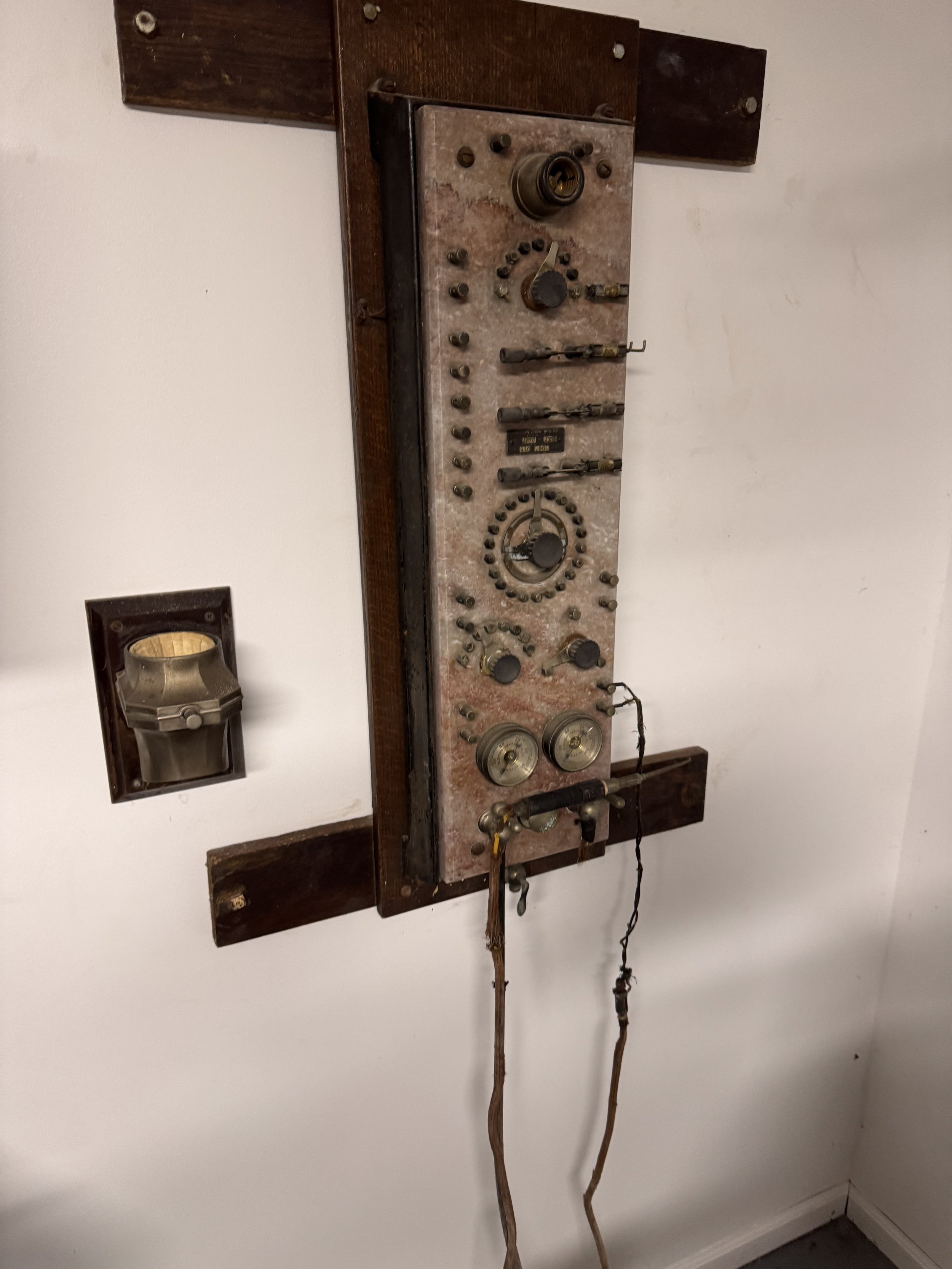
Mounted vertically on heavy wood backing is a tall panel faced with stone, packed with switches, dials, and gauges. A few lines still hang from the bottom. It looks more like a control station than a piece of office furniture, and that is exactly the point.
This artifact represents the moment dentistry became a powered profession.
What the panel is, and what it did
It is a truly fascinating revolutionary early electric and compressed air control “switchboard” for a dental operatory, specifically what Ritter Dental Manufacturing Company (Rochester, New York) marketed as a Ritter Distributing Panel. The Ritter catalog that describes it is copyrighted 1919. In the early 1900s, a dental office was not simply a chair and a tray. A working operatory increasingly relied on electricity and compressed air to run equipment that earlier generations did by hand or foot power. Rather than wiring each device separately, many offices used a centralized utility panel like this one to manage the room’s “systems” in one place.
The switches and controls on the panel were used to route and control power for dental equipment and room lighting, and to manage air delivery that supported tools and chair side functions. The gauges near the bottom indicate pressure monitoring, consistent with compressed air being part of the setup.
In practice, a dentist could stand up from the chair, reach to the wall, and control what the room needed for the next step, with less trial and error and more repeatability. The panel is not only a piece of hardware, it is a snapshot of workflow, a reminder that modern dental care required dependable utilities long before standardized office layouts made that invisible.
When visitors see it today, it reads as complex. For a working dentist, it was about efficiency and control.
The room around it
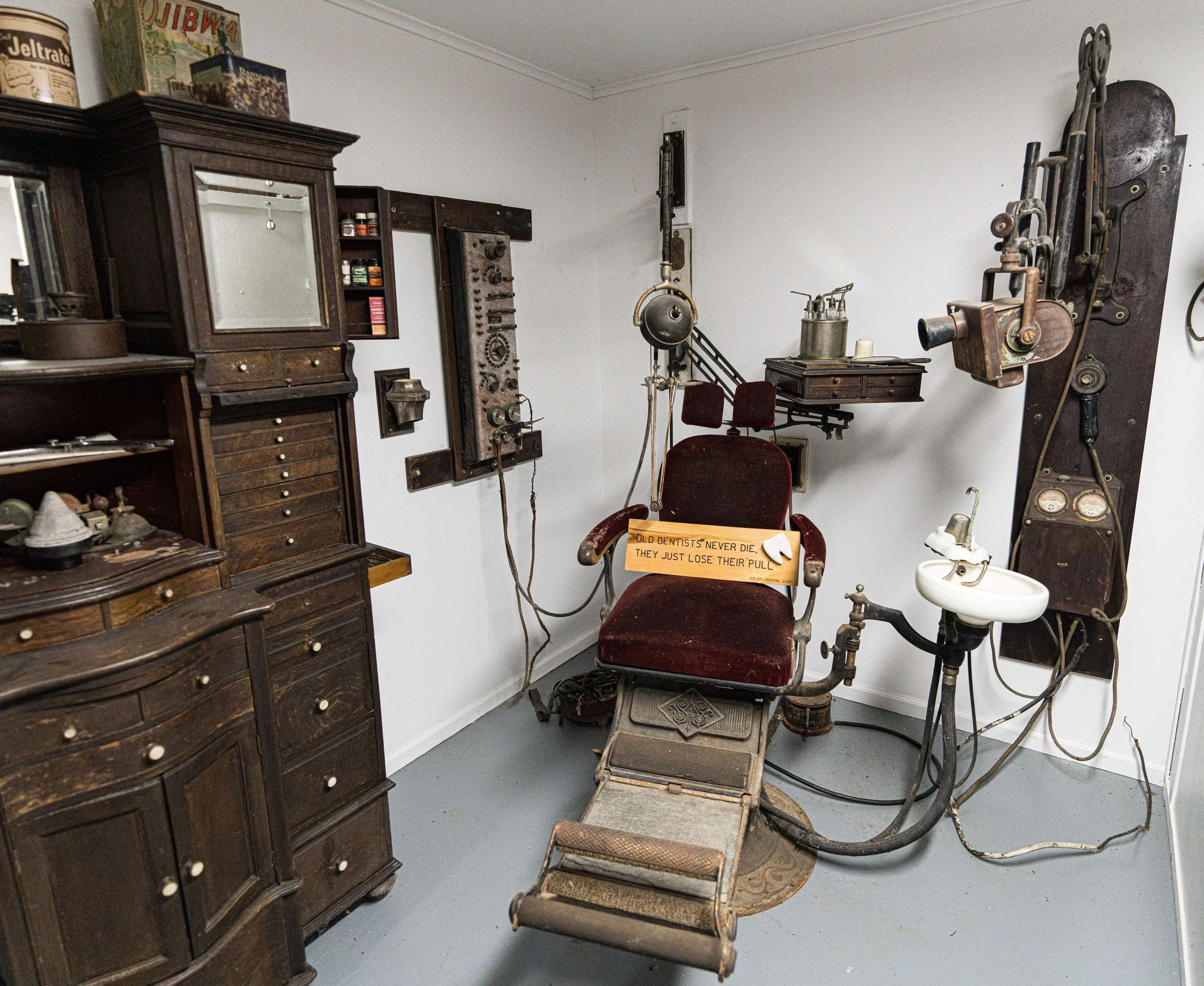
A second view of the office, also in the Red Barn, helps put the panel in context. The patient chair sits centered, with cabinetry and storage close at hand. The tool stands and delivery components sit to the right, showing how the dentist’s work area surrounded the patient.
In that environment, the wall panel was the quiet backbone of the room. It was the behind the scenes coordination point that supported the hands on care happening at the chair.
The dentist connected to the artifact: Dr. Jerry Emery Blosser
The story of this panel is stronger when it is connected to a name and a life.
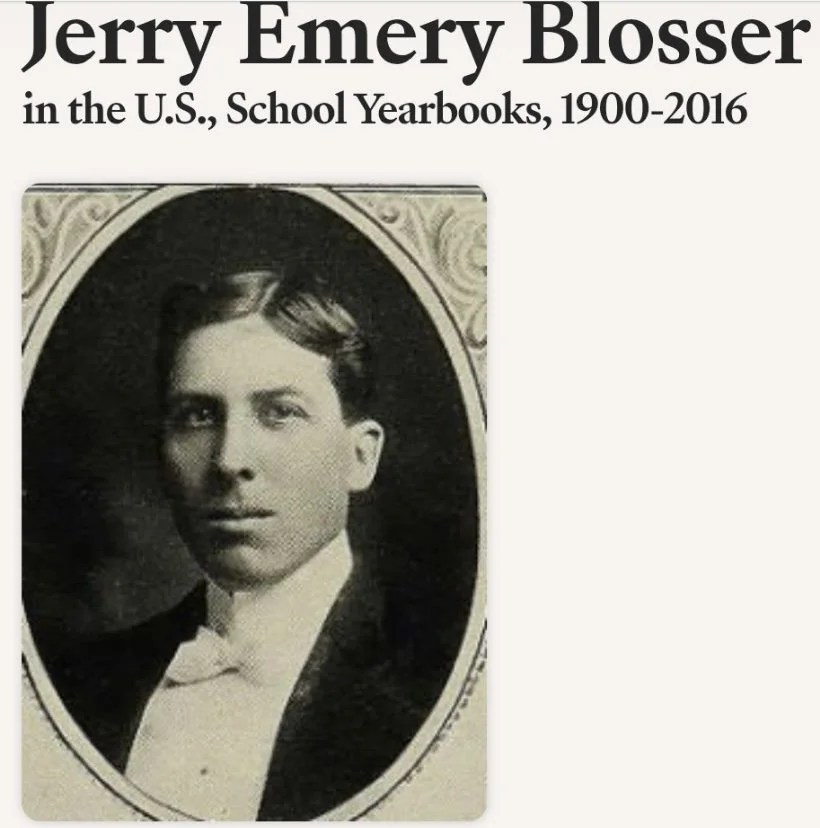
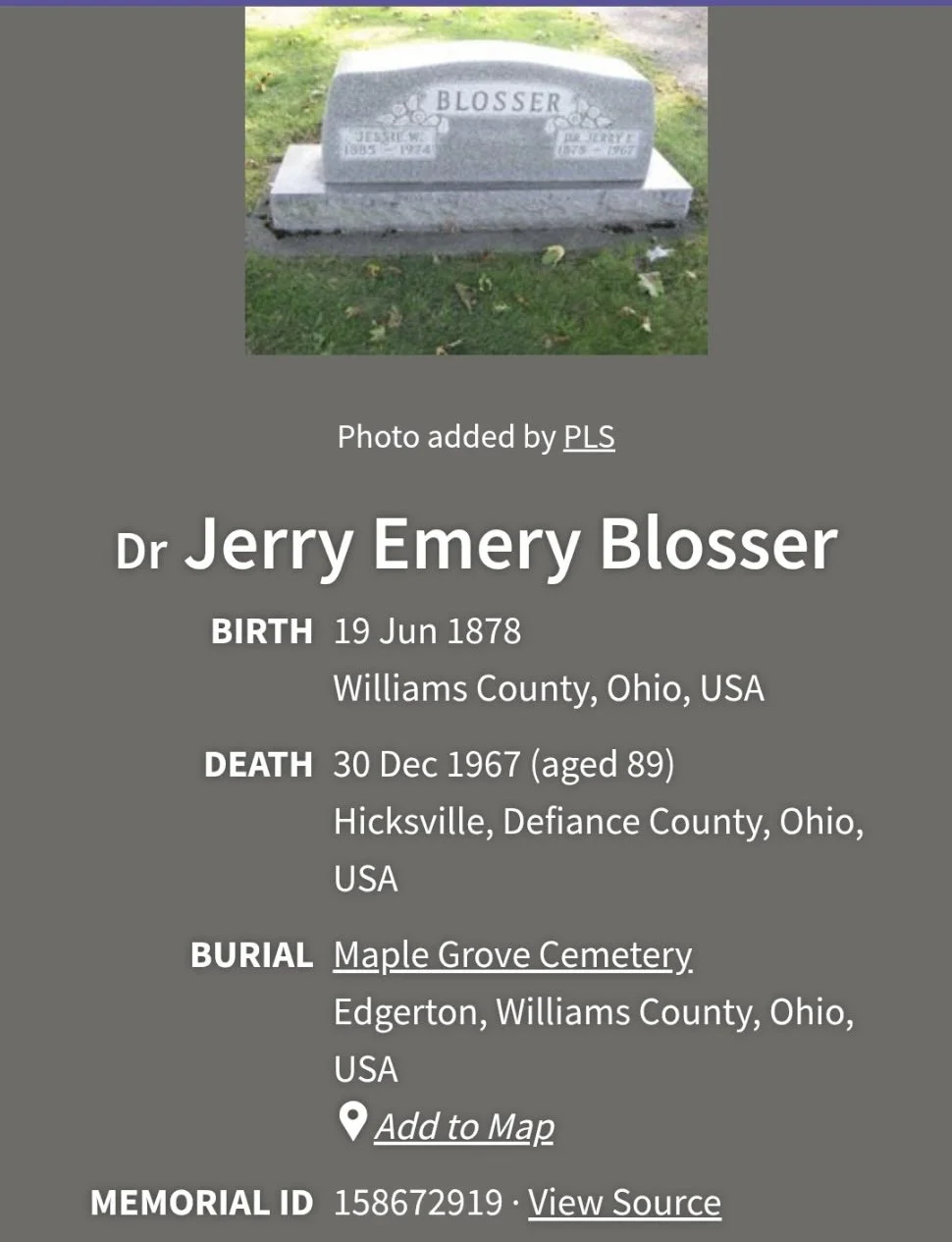
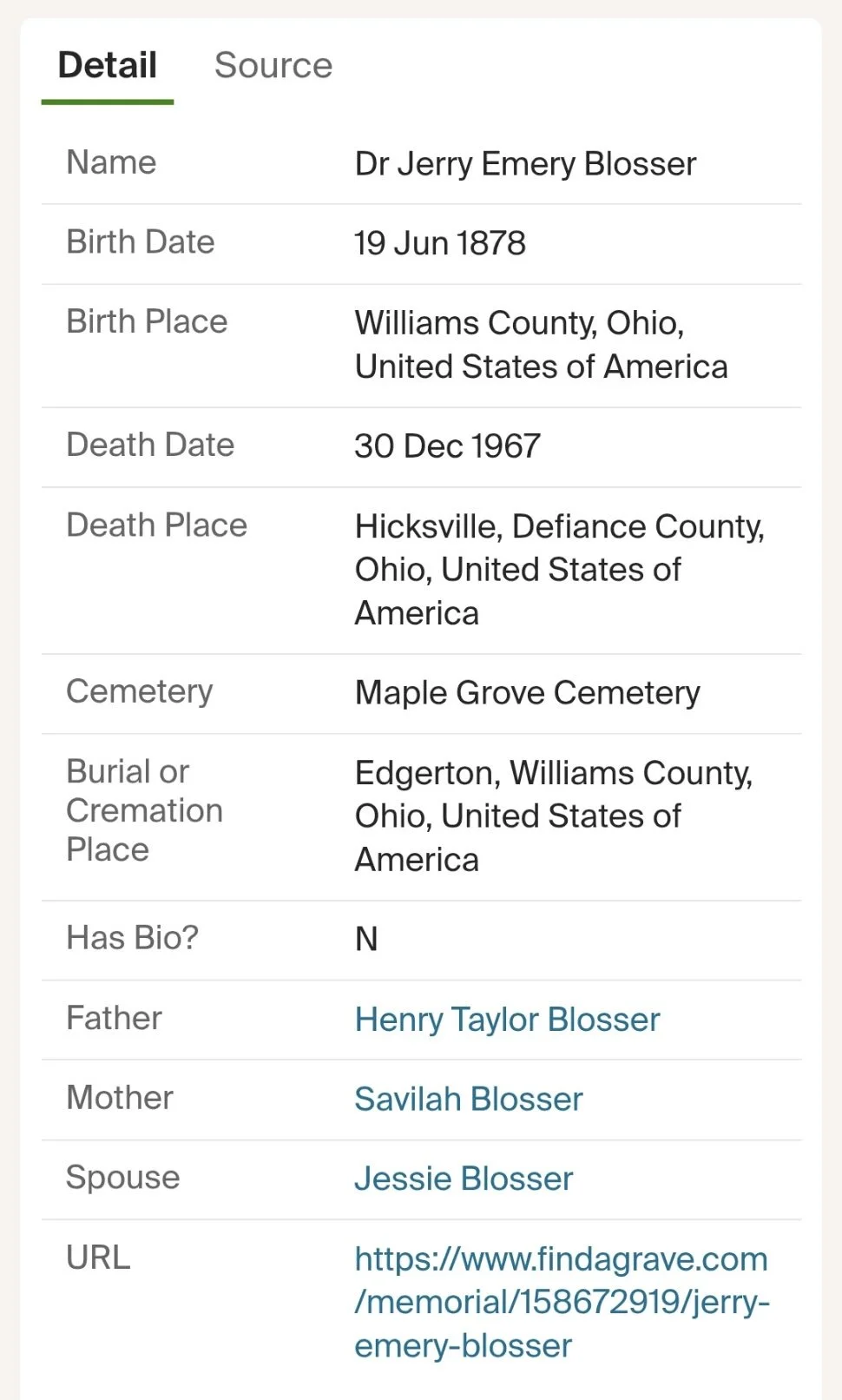
Dr Jerry Emery Blosser was born on June 19th, 1878, in Williams County, Ohio. He died on December 30th, 1967, in Hicksville, Ohio, and was buried in Maple Grove Cemetery in Edgerton. He spent his working life in the same region that AuGlaize Village interprets today.
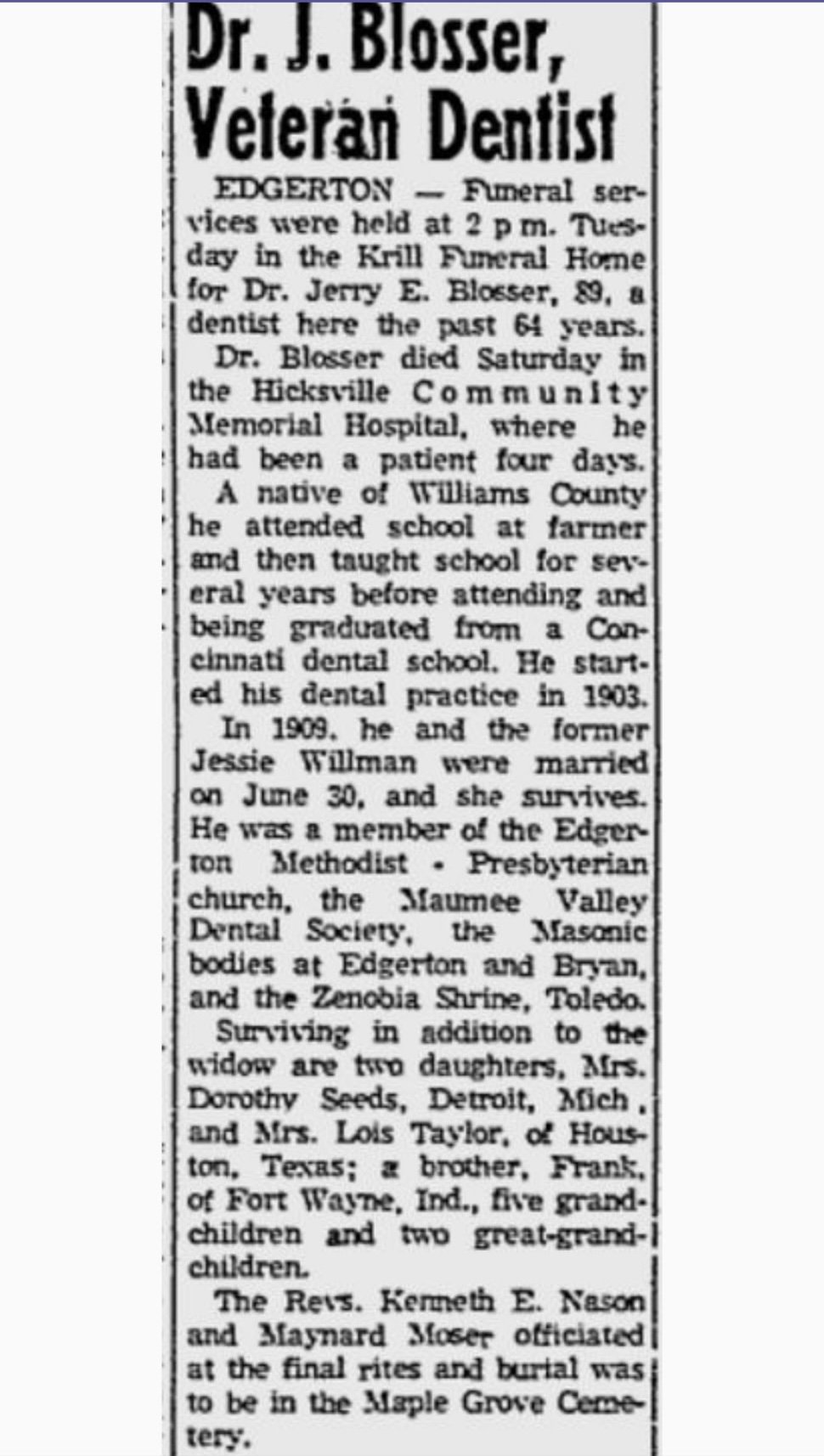
A published obituary described Dr Blosser as a veteran dentist and stated that he had practiced dentistry in Edgerton for 64 years. It reported that he died at Hicksville Community Memorial Hospital after being a patient for four days.
The obituary also described his route into the profession. It stated that he attended school at Farmer, then taught school for several years before attending and graduating from a Cincinnati dental school. It noted that he started his dental practice in 1903.
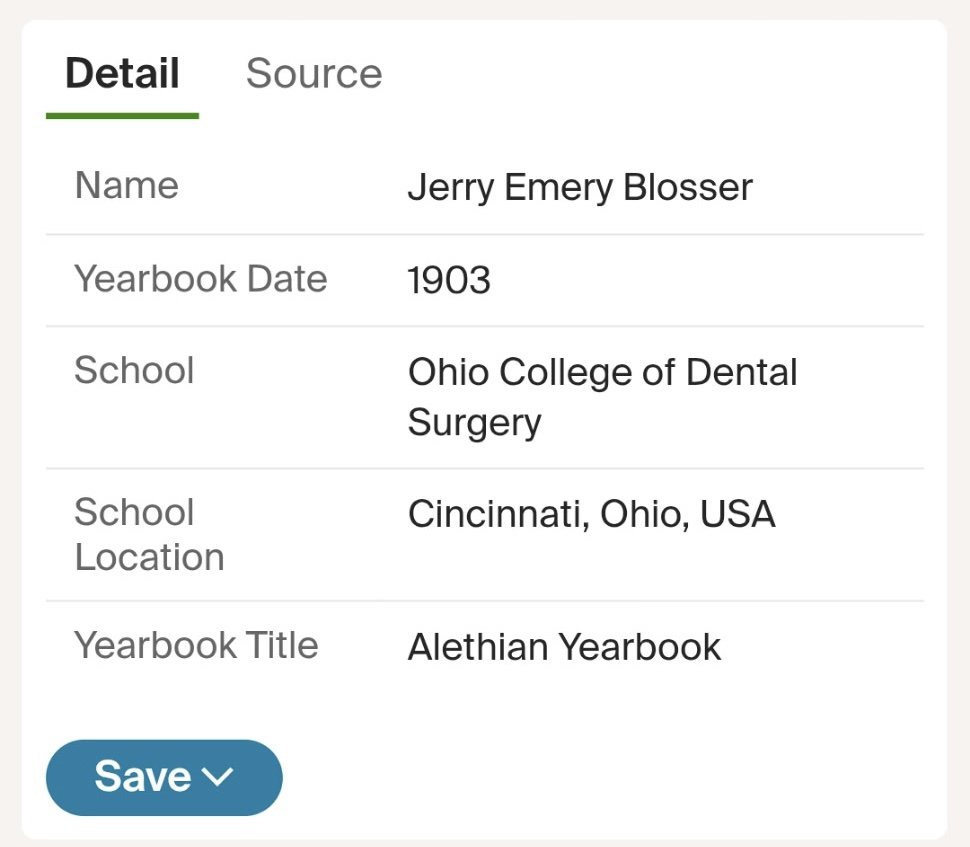
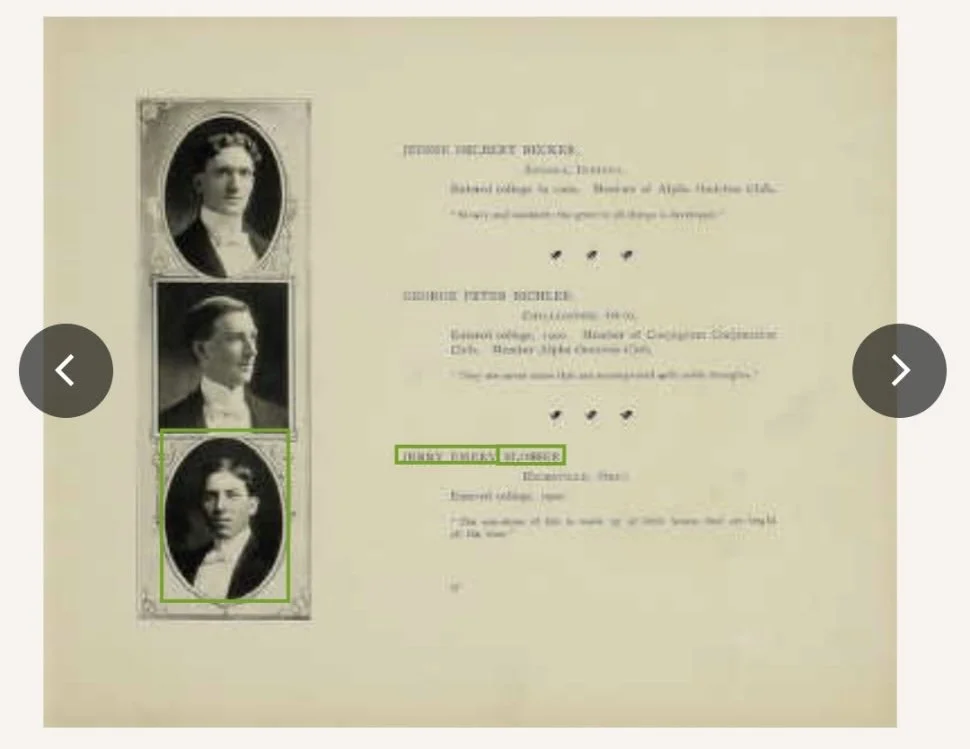
A separate yearbook record reinforces that education timeline by listing Jerry Emery Blosser with the Ohio College of Dental Surgery in Cincinnati in 1903, associated with the Alethian Yearbook. A portrait image from that period shows him as a young man at the start of his professional path.
In 1909, he married Jessie Willman on June 30th, according to the obituary. The same obituary listed his community affiliations, including membership in the Edgerton Methodist Presbyterian church, the Maumee Valley Dental Society, and Masonic organizations in Edgerton and Bryan, along with the Zenobia Shrine in Toledo.
The obituary also listed survivors, including his wife and two daughters, Dorothy Seeds of Detroit, Michigan, and Lois Taylor of Houston, Texas, as well as a brother, Frank, of Fort Wayne, Indiana, plus grandchildren and great grandchildren.
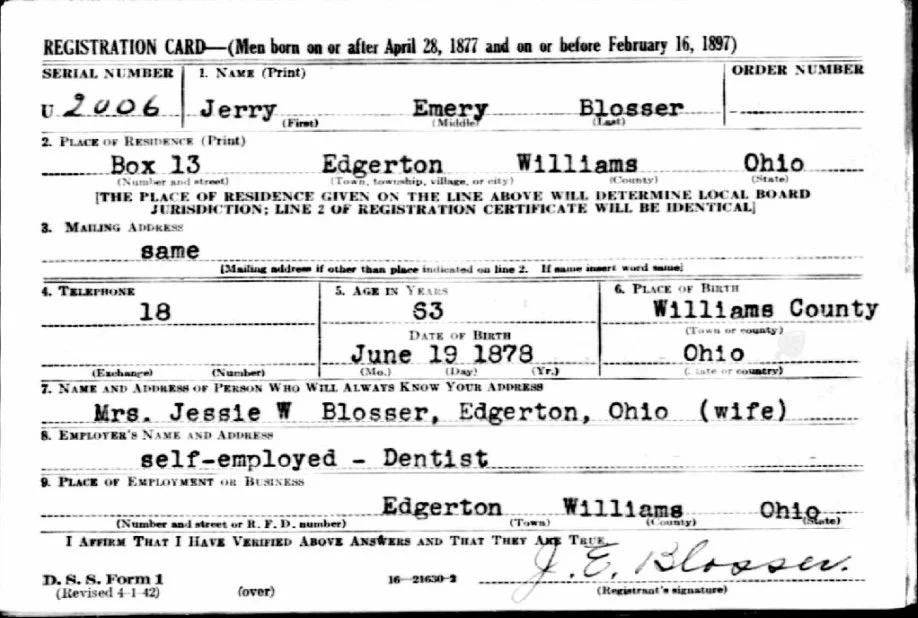
A plainspoken document from 1942
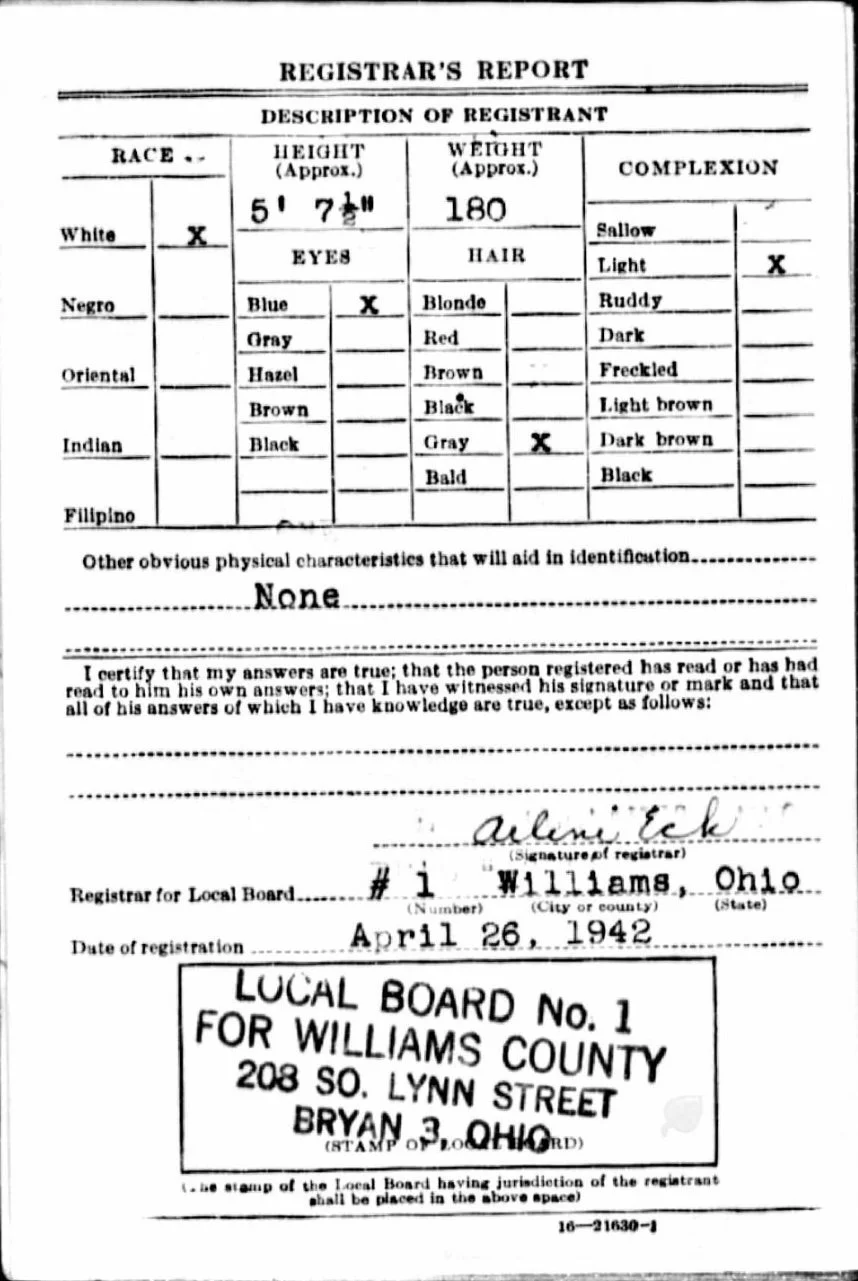
One of the most humanizing pieces of information comes from a registration record dated April 26th, 1942.
On that card, Dr Blosser is listed as self employed, with his occupation given simply as dentist. His residence is recorded as Box 13 in Edgerton. The person who would always know his address is listed as Mrs Jessie W Blosser of Edgerton, identified as his wife.
The registrar’s report attached to that record captures a brief physical description, including a height of 5 feet, 7 and one half inches, a weight of 180 pounds, blue eyes, and gray hair, with no other obvious identifying characteristics noted.
It is a routine document meant for administration, but it quietly anchors the story in time. By 1942, Dr Blosser was in his early fifties, established in practice, and still serving a community that depended on local professionals.
Why the Ritter Distributing Panel matters at AuGlaize Village
AuGlaize Village exists to preserve the everyday working world of earlier generations in northwest Ohio. This dental office display & Artifact does that in a way visitors can immediately understand, because it is both personal and technical.
The chair and cabinetry speak to the patient experience. The Ritter Distributing Panel speaks to the systems that made care possible.
For many visitors, the panel will be the unexpected detail. It makes people pause and ask questions, because it looks like infrastructure, not decoration. That is the educational value. It reminds us that the modernization of medicine did not arrive all at once, and it did not happen only in big cities. It happened in small towns and rural regions, office by office, as professionals invested in equipment that improved the quality and consistency of care.
Dr Blosser’s career began in 1903 and stretched across decades of change in dentistry and in American life. This panel, preserved in the Red Barn at AuGlaize Village, gives that timeline a physical presence, something visitors can stand in front of and consider. It connects the history of technology to the history of service.
What we do not know yet, and why that matters too
At this time, AuGlaize Village knows the dental office is located in the Red Barn, but the exact date when the office was moved and donated is not currently known. That is not unusual with historic material. Objects often outlive paperwork, and community collections sometimes grow through informal transfers before records catch up.
In some ways, that gap becomes an invitation. If a visitor, family member, or local historian recognizes details about the office’s original location or remembers when it was moved, that knowledge can help complete the story for future generations.
Visit and look closely
The next time you walk through the Red Barn, take a moment with the wall panel. Look at the density of the controls. Look at how close it sits to the chair, placed for use, not display. Then look back at the room and imagine it as a working office, with a patient in the chair and a dentist reaching to the wall to power the tools of his era.
It is one artifact, but it carries a full chapter of local life, and it keeps the name of Dr Jerry Emery Blosser connected to the working history of the region he served.
Come Back in a few weeks for the next AuGlaize Artifact!